


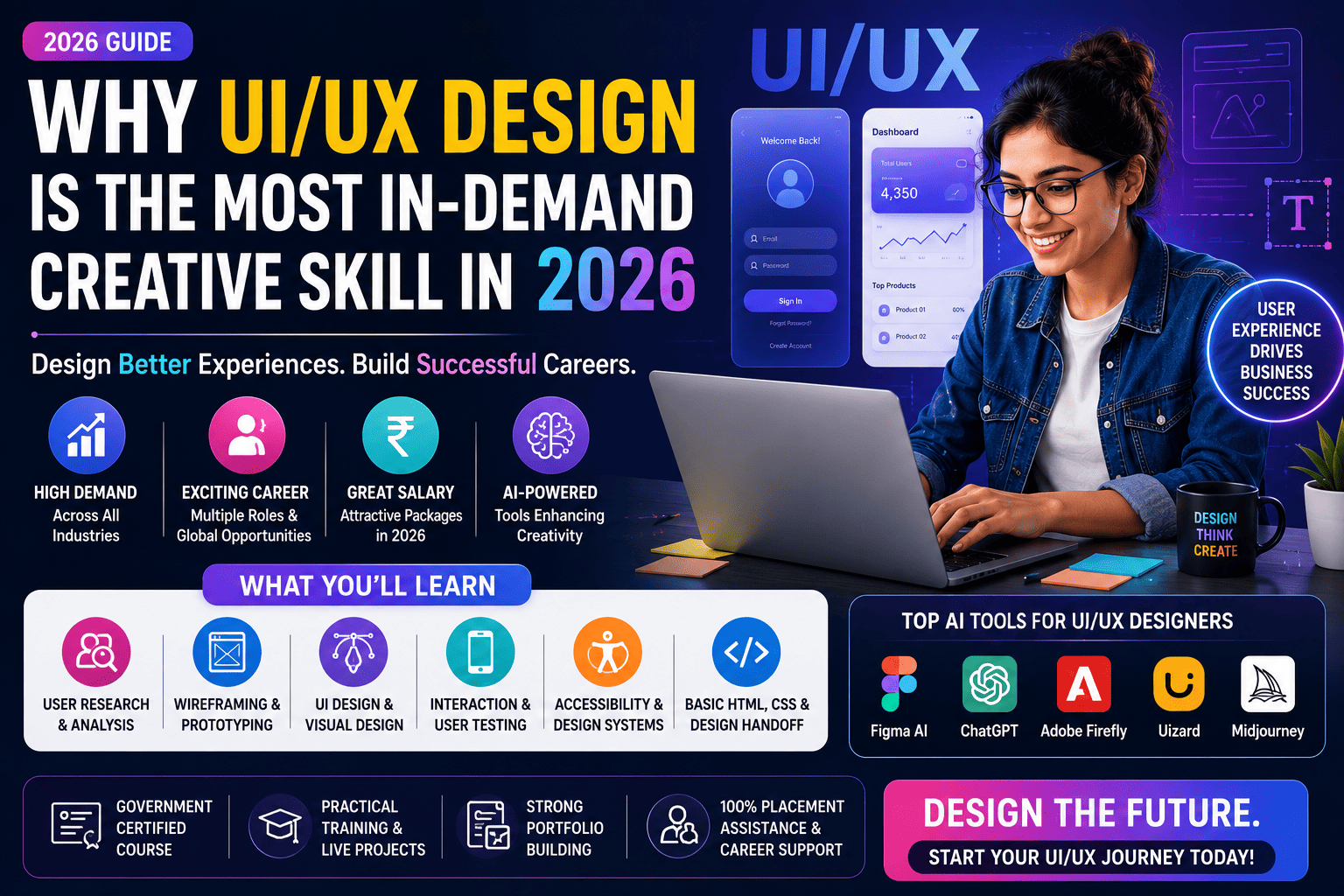
Digital products have become an essential part of everyday life. From banking and shopping to healthcare, education, entertainment, and government services, people expect websites and mobile apps to be intuitive, fast, and visually engaging. Behind every successful digital product is a well-designed user experience.
This growing demand has made UI/UX Design one of the most sought-after creative skills in 2026. Organizations are investing heavily in user-centered design because a better user experience leads to improved customer satisfaction, higher engagement, and stronger business results.
Whether you are a student after 12th, a graduate, a working professional, or someone looking to switch careers, learning UI/UX Design—along with complementary skills such as Graphic Design, Website Development, Motion Graphics, Digital Marketing, and Generative AI—can prepare you for a wide range of opportunities in the digital economy.
What Is UI/UX Design?
UI (User Interface) Design focuses on the visual elements users interact with, such as buttons, layouts, colors, icons, and typography.
UX (User Experience) Design focuses on how users navigate and interact with digital products, ensuring that websites and applications are easy to use, accessible, and enjoyable.
Together, UI and UX create digital experiences that balance aesthetics with usability.
Why UI/UX Design Is the Most In-Demand Skill in 2026
1. Every Business Needs a Digital Presence
Businesses across industries rely on websites, mobile apps, customer portals, and digital platforms to connect with users.
As digital transformation accelerates, organizations need designers who can create intuitive and engaging user experiences.
Industries hiring UI/UX Designers include:
- IT & Software
- E-commerce
- Healthcare
- Education Technology
- Banking & Finance
- Travel & Hospitality
- Manufacturing
- Government Services
- Media & Entertainment
- Startups
2. Better User Experience Drives Business Growth
Companies recognize that a well-designed interface can improve:
- Customer satisfaction
- Conversion rates
- User retention
- Accessibility
- Brand trust
- Customer loyalty
This business impact makes UI/UX Design a strategic function rather than just a creative role.
3. Demand Continues to Grow
As organizations launch new digital products and improve existing ones, the need for skilled UI/UX professionals continues to increase.
The rise of AI-powered applications, SaaS platforms, fintech, and smart devices has further expanded opportunities for UI/UX Designers.
What Does a UI/UX Designer Do?
A UI/UX Designer works throughout the product design process.
Typical responsibilities include:
- Conducting user research
- Creating user personas
- Designing user journeys
- Building wireframes
- Developing interactive prototypes
- Designing visual interfaces
- Testing usability
- Collaborating with developers and product teams
Skills Every UI/UX Designer Should Learn
Design Skills
- User Research
- Wireframing
- Prototyping
- Information Architecture
- Interaction Design
- Design Systems
- Accessibility
- Responsive Design
Soft Skills
- Problem-solving
- Communication
- Empathy
- Critical thinking
- Collaboration
- Creativity
Essential Software for UI/UX Designers
Modern UI/UX professionals commonly use:
- Figma
- Adobe XD
- FigJam
- Miro
- Photoshop
- Illustrator
Learning these tools alongside design principles enables you to create professional-quality digital experiences.
How Generative AI Is Changing UI/UX Design
Artificial Intelligence is transforming design workflows by helping professionals:
- Generate interface ideas
- Create design variations
- Produce icons and illustrations
- Summarize research findings
- Draft UX content
- Build rapid prototypes
- Automate repetitive tasks
Popular AI tools include:
- ChatGPT
- Adobe Firefly
- Figma AI features
- Midjourney
- Canva AI
- Runway
AI enhances productivity, but human creativity, empathy, and strategic thinking remain central to successful UX design.
Career Opportunities in UI/UX Design
A background in UI/UX Design can lead to roles such as:
- UI Designer
- UX Designer
- Product Designer
- UX Researcher
- Interaction Designer
- Information Architect
- Design System Specialist
- Mobile App Designer
- Web Interface Designer
Professionals with additional knowledge of Graphic Design, Website Development, and Digital Marketing often have broader career opportunities.
Salary Potential in 2026
Salary varies based on factors such as:
- Experience
- Portfolio quality
- Location
- Industry
- Company size
- Technical expertise
- AI proficiency
Professionals who continuously build their skills, demonstrate practical experience, and maintain a strong portfolio are generally well-positioned for career growth and competitive compensation.
Why Learn Website Design Along with UI/UX?
UI/UX Designers who understand website development can:
- Collaborate more effectively with developers
- Create technically feasible designs
- Improve responsive layouts
- Design better user experiences across devices
Basic knowledge of HTML, CSS, and responsive design is often beneficial.
The Value of Graphic Design Skills
Graphic Design complements UI/UX by strengthening:
- Typography
- Color theory
- Branding
- Visual hierarchy
- Iconography
- Layout composition
These skills help designers create interfaces that are both functional and visually appealing.
Why Digital Marketing Knowledge Matters
Understanding Digital Marketing allows UI/UX Designers to:
- Design conversion-focused landing pages
- Improve user engagement
- Support SEO best practices
- Optimize customer journeys
- Align design with business goals
Cross-functional knowledge makes designers more versatile and valuable.
Government Certification: Why It Matters
Government-recognized certification can demonstrate that you have completed structured training and achieved specific learning outcomes. However, certification alone is not enough.
Employers typically evaluate candidates based on:
- Practical skills
- Portfolio quality
- Real-world projects
- Problem-solving ability
- Communication skills
A certification is most valuable when paired with hands-on experience and continuous learning.
How to Become a UI/UX Designer
- Learn UI/UX fundamentals.
- Understand user-centered design principles.
- Master Figma and other design tools.
- Practice wireframing and prototyping.
- Study usability and accessibility.
- Learn basic web technologies.
- Explore AI-assisted design workflows.
- Build a portfolio with real projects.
- Seek feedback and refine your work.
- Continue learning as technologies evolve.
Who Should Learn UI/UX Design?
This field is suitable for:
- Students after 12th
- College students
- Graduates
- Working professionals
- Career changers
- Freelancers
- Entrepreneurs
- Graphic Designers
- Web Designers
- Digital Marketers
No prior coding experience is required for many entry-level UI/UX roles.
Future Trends in UI/UX Design
The future of UI/UX is shaped by:
- AI-assisted design
- Voice interfaces
- Augmented Reality (AR)
- Virtual Reality (VR)
- Wearable technology
- Accessibility-first design
- Inclusive design
- Personalized user experiences
- Design systems
- Ethical AI experiences
Professionals who stay informed about these trends will be better prepared for future opportunities.
Frequently Asked Questions (FAQs)
1. Why is UI/UX Design in high demand?
As businesses increasingly rely on digital products, they need professionals who can create intuitive, accessible, and engaging user experiences that support customer satisfaction and business goals.
2. Do I need coding knowledge to become a UI/UX Designer?
Coding is not mandatory for many UI/UX roles. However, basic knowledge of HTML, CSS, and responsive design can improve collaboration with development teams.
3. Can beginners learn UI/UX Design?
Yes. Beginners can start with design principles, user research, wireframing, and prototyping before progressing to more advanced topics and practical projects.
4. Are AI tools replacing UI/UX Designers?
AI is automating certain tasks and assisting with ideation, but human skills such as empathy, research, creativity, and strategic decision-making remain essential to effective user experience design.
5. Is a government-certified UI/UX course enough to get a job?
Certification can strengthen your profile, but employers generally look for a combination of practical skills, a strong portfolio, real-world projects, and the ability to solve user problems.
6. Which additional skills complement UI/UX Design?
Graphic Design, Website Design & Development, Motion Graphics, Digital Marketing, and Generative AI are valuable complementary skills that can broaden your career opportunities.
Conclusion
UI/UX Design has become one of the most valuable creative skills in 2026 because it sits at the intersection of technology, design, and business. As organizations continue to prioritize digital experiences, the demand for professionals who can design intuitive, accessible, and user-focused products is expected to remain strong.
To build a future-ready career, focus on mastering UI/UX fundamentals while expanding your expertise in Graphic Design, Website Design & Development, Motion Graphics, Digital Marketing, and Generative AI. Pair technical knowledge with practical projects, a compelling portfolio, and a commitment to continuous learning. By doing so, you’ll be well-equipped to adapt to evolving technologies and contribute meaningfully to the future of digital product design.
Comments are closed