


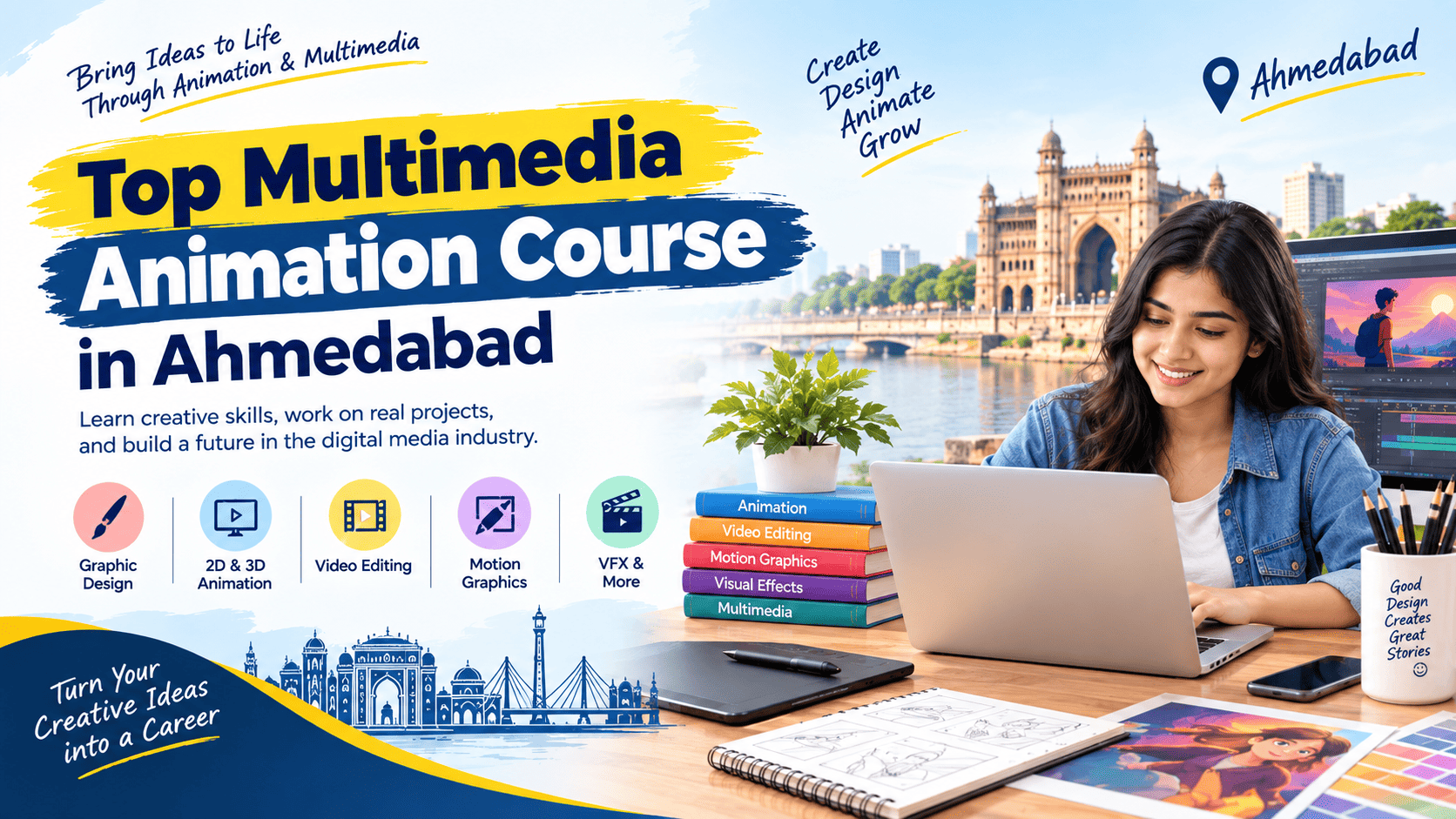
Multimedia and animation have become important parts of today’s creative and digital industries. From films and advertisements to social media, gaming, websites, educational content, and digital media, animation and visual storytelling are used in many different fields.
For students and beginners interested in a creative career, a Multimedia Animation Course in Ahmedabad can provide practical knowledge of graphic design, 2D animation, 3D concepts, motion graphics, video editing, visual effects, digital filmmaking, and other creative skills.
If you are searching for the Top Multimedia Animation Course in Ahmedabad, it is important to compare the course fees, duration, syllabus, software, practical projects, training method, portfolio development, certification, and career opportunities.
This guide explains the major things you should know before choosing a Multimedia Animation Course in Ahmedabad in 2026.
What Is Multimedia Animation?
Multimedia animation combines different forms of visual communication, including graphics, animation, video, sound, typography, and motion.
Animation is the process of creating the appearance of movement by displaying visual elements in sequence. Multimedia expands this concept by combining multiple forms of digital content to create engaging experiences.
Multimedia and animation can be used for:
- Films and entertainment
- Advertisements
- Social media content
- YouTube videos
- Motion graphics
- Games
- Websites
- Educational videos
- Product presentations
- Digital campaigns
- Corporate videos
- Digital filmmaking
- Visual effects
Why Choose a Multimedia Animation Course in Ahmedabad?
Ahmedabad has a growing creative, digital, advertising, media, education, and technology ecosystem. This creates opportunities for people interested in creative digital careers.
1. Creative Career Opportunities
Multimedia provides opportunities for people interested in visual storytelling, design, animation, video, and digital content.
2. Multiple Specialisations
Students can explore areas such as:
- Graphic design
- 2D animation
- 3D animation
- Motion graphics
- Video editing
- Visual effects
- Digital filmmaking
- UI design
- Multimedia production
3. Growing Digital Content
Businesses and creators increasingly use videos, animations, and visual content for marketing and communication.
4. Freelancing Potential
Skilled professionals can work on projects such as promotional videos, social media animations, motion graphics, video editing, presentations, and other digital content.
5. Portfolio-Based Career
Creative industries often value practical skills and portfolios. Students can demonstrate their abilities through projects rather than relying only on certificates.
What Should You Learn in a Multimedia Animation Course?
A comprehensive course should cover both creative fundamentals and practical digital production.
Important areas may include:
- Design fundamentals
- Graphic design
- Digital illustration
- Typography
- Colour theory
- Image editing
- 2D animation
- 3D fundamentals
- Motion graphics
- Video editing
- Visual effects
- Storyboarding
- Character design
- Digital filmmaking
- Audio and video basics
- Portfolio development
The exact syllabus depends on the institute and program.
Multimedia Animation Course Syllabus
A professional Multimedia Animation Course in Ahmedabad may include the following modules.
1. Design Fundamentals
Before learning advanced animation, students should understand basic design principles.
Topics can include:
- Colour theory
- Typography
- Composition
- Balance
- Contrast
- Visual hierarchy
- Layout
- Shapes
- Design principles
These fundamentals help students create visually effective designs.
2. Graphic Design
Graphic design is an important foundation for multimedia.
Students may learn:
- Poster design
- Brochure design
- Social media creatives
- Banner design
- Branding basics
- Layout design
- Digital advertisements
- Image composition
Graphic design skills can also support careers outside animation.
3. Digital Illustration
Digital illustration focuses on creating and editing artwork digitally.
Students may explore:
- Drawing fundamentals
- Digital sketching
- Shapes
- Character concepts
- Illustration techniques
- Visual storytelling
- Creative compositions
4. 2D Animation
2D animation involves creating movement using two-dimensional artwork and graphics.
Students can learn concepts such as:
- Animation principles
- Keyframes
- Timing
- Spacing
- Character movement
- Object animation
- Scene composition
- Storytelling
2D animation is widely used in advertisements, educational videos, explainer content, social media, and entertainment.
5. 3D Animation Fundamentals
3D animation involves creating objects and environments in a three-dimensional space.
A course may introduce:
- 3D modelling
- Texturing
- Lighting
- Camera movement
- Rigging basics
- Character animation
- Rendering
- 3D environments
Students interested in film, gaming, product visualisation, and VFX can benefit from learning 3D concepts.
6. Motion Graphics
Motion graphics combines graphic design with animation.
It is commonly used for:
- Advertisements
- Social media videos
- YouTube intros
- Brand videos
- Promotional content
- Title sequences
- Presentations
- Explainer videos
Students learn how to bring text, shapes, graphics, and visual elements to life through movement.
7. Video Editing
Video editing is another important part of multimedia production.
Students may learn:
- Timeline editing
- Cutting and trimming
- Transitions
- Audio editing
- Colour correction
- Text overlays
- Video effects
- Story structure
- Export settings
Video editing skills are useful for agencies, production houses, social media teams, content creators, and businesses.
8. Visual Effects
Visual effects, commonly known as VFX, involve creating or enhancing visual elements that may be difficult or impossible to capture directly during filming.
A course may introduce:
- Compositing
- Green-screen techniques
- Visual effects
- Motion tracking
- Masking
- Rotoscoping
- Background replacement
- Basic compositing
9. Storyboarding
Storyboarding helps plan how a video, animation, or film will develop visually.
Students can learn how to plan:
- Scenes
- Camera angles
- Characters
- Movement
- Transitions
- Visual sequences
A storyboard acts as a visual roadmap before production begins.
10. Character Design
Character design is important for animation and storytelling.
Students may learn:
- Character concepts
- Character shapes
- Expressions
- Poses
- Clothing
- Character personality
- Turnaround sheets
- Basic character development
11. Digital Filmmaking
Students interested in filmmaking may explore:
- Story development
- Script basics
- Shot composition
- Camera basics
- Lighting
- Audio
- Editing
- Post-production
Combining filmmaking with animation and multimedia can provide a broader creative skill set.
12. Portfolio Development
A good animation course should give students opportunities to build a portfolio.
Portfolio projects may include:
- Animated advertisements
- Short animations
- Motion graphics
- Brand videos
- Character designs
- Video-editing projects
- 3D projects
- Social media videos
- Short films
- Visual effects projects
A portfolio helps employers and clients understand a student’s actual capabilities.
Software Used in Multimedia Animation
Depending on the course, students may work with different creative software.
Commonly used software can include:
- Adobe Photoshop
- Adobe Illustrator
- Adobe After Effects
- Adobe Premiere Pro
- Blender
- Autodesk Maya
- Adobe Animate
- Audition
- Other 2D, 3D, editing, and compositing tools
The software taught depends on the institute, course level, and current industry requirements.
Important: Learning software is only one part of becoming an animation professional. Students should also understand design, storytelling, composition, timing, visual communication, and creative problem-solving.
Multimedia Animation Course Fees in Ahmedabad
The fees for a Multimedia Animation Course in Ahmedabad vary according to the institute, duration, syllabus, software, practical training, projects, and certification.
An approximate market range can be:
| Course Type | Approximate Fee Range |
|---|---|
| Short-Term Animation Course | ₹10,000 – ₹25,000 |
| Certificate Course | ₹25,000 – ₹50,000 |
| Professional Multimedia Program | ₹50,000 – ₹1,00,000 |
| Advanced Animation Program | ₹1,00,000+ |
These are indicative ranges only. Actual fees can differ considerably between institutes and programs.
Before enrolling, check the latest fee structure and confirm whether software training, projects, certification, internship, and other services are included.
Multimedia Animation Course Duration in Ahmedabad
Course duration depends on the depth of the curriculum.
Typical formats include:
- Short-term courses: 1–3 months
- Certificate programs: 3–6 months
- Professional programs: 6–12 months
- Advanced programs: 1 year or longer
If your goal is to build a career, choose a program that provides enough time for practice, assignments, projects, feedback, and portfolio development.
Online vs Classroom Multimedia Animation Training
Students can choose online or classroom training based on their learning preferences.
Online Multimedia Animation Course
Online learning can be useful for students who need flexibility.
Advantages:
- Learn from home
- Flexible schedule
- No daily travel
- Convenient for working professionals
- Access to digital learning materials
- Suitable for learners outside Ahmedabad
However, students need a suitable computer and enough time for regular practice.
Classroom Multimedia Animation Course
Classroom training provides direct interaction with trainers and other students.
Advantages:
- Face-to-face guidance
- Immediate feedback
- Practical demonstrations
- Structured learning
- Classroom activities
- Direct trainer interaction
- Peer learning
For beginners who prefer guided learning, classroom training can be a useful option.
Which Is Better: Online or Classroom?
Neither method is automatically better.
Choose online training if flexibility and convenience are your priorities.
Choose classroom training if you prefer personal guidance and a structured learning environment.
For multimedia and animation, practical work is especially important. Therefore, regardless of the learning mode, check whether the course provides:
Practical assignments + projects + trainer feedback + portfolio development.
Career Opportunities After Multimedia Animation
A Multimedia Animation Course can lead to different creative career paths.
1. 2D Animator
Creates movement and visual storytelling using two-dimensional artwork.
2. 3D Animator
Creates animated objects, characters, and scenes in three-dimensional environments.
3. Motion Graphics Designer
Creates animated graphics, typography, visual effects, and promotional content.
4. Video Editor
Edits footage, audio, graphics, transitions, and visual effects to create finished videos.
5. Graphic Designer
Creates visual content for branding, advertising, digital media, and communication.
6. VFX Artist
Works with visual effects, compositing, tracking, and other post-production processes.
7. 3D Modelling Artist
Creates three-dimensional objects, characters, environments, and product models.
8. Character Designer
Develops the appearance, personality, expressions, and visual style of animated characters.
9. Multimedia Designer
Combines graphics, animation, video, audio, and other digital media to create interactive content.
10. Digital Content Creator
Creates videos, animations, graphics, and other digital content for online platforms.
Industries That Hire Multimedia Professionals
Multimedia and animation skills can be useful across various industries, including:
- Animation studios
- Film production
- Advertising agencies
- Gaming companies
- Digital marketing agencies
- Media companies
- E-learning companies
- Television production
- OTT content production
- Corporate communication
- E-commerce
- Education
- Social media agencies
- Product companies
Multimedia Animation Career Scope in 2026
The demand for visual content continues to create opportunities for multimedia professionals.
Businesses use animation and video for:
- Product promotion
- Social media campaigns
- Explainer videos
- Advertisements
- Training materials
- Presentations
- Brand storytelling
- Educational content
At the same time, entertainment and gaming industries continue to require specialised creative professionals.
The strongest career opportunities generally go to professionals who combine creative skills, technical knowledge, storytelling, and a strong portfolio.
Multimedia Animation Salary in Ahmedabad
Salary depends on several factors, including:
- Job role
- Experience
- Technical skills
- Specialisation
- Portfolio
- Company
- Industry
- Project experience
Freshers generally begin with entry-level positions, while professionals with specialised skills and experience can progress to senior roles.
Instead of choosing a course only based on expected salary, focus on building strong fundamentals, practical projects, software skills, and a professional portfolio.
Skills Required for a Multimedia Animation Career
Technical knowledge is important, but creative and professional skills are equally valuable.
Important skills include:
- Creativity
- Visual storytelling
- Drawing fundamentals
- Design thinking
- Colour knowledge
- Typography
- Composition
- Animation principles
- Video editing
- Attention to detail
- Time management
- Communication
- Problem-solving
- Teamwork
A successful multimedia professional should be able to turn an idea into an effective visual experience.
How to Build a Multimedia Animation Portfolio
A portfolio is one of the most important assets when applying for creative jobs.
Instead of displaying only finished images, show a variety of projects that demonstrate different skills.
Your portfolio could include:
Graphic Design
Posters, branding concepts, social media creatives, and advertisements.
Animation
2D animations, character animation, object animation, and short animated sequences.
Motion Graphics
Animated typography, promotional graphics, title sequences, and brand videos.
Video Editing
Short-form videos, promotional videos, reels, and storytelling projects.
3D
Modelling, texturing, lighting, environments, and animation.
VFX
Compositing, tracking, green-screen work, and visual effects.
A well-organised portfolio can make your skills easier for employers and clients to evaluate.
Who Can Join a Multimedia Animation Course?
A Multimedia Animation Course can be suitable for:
- Students after 10th or 12th
- College students
- Graduates
- Beginners
- Graphic designers
- Video editors
- Content creators
- Digital marketers
- Freelancers
- Photography enthusiasts
- Creative professionals
- Entrepreneurs
You do not necessarily need to be an expert artist before beginning. Basic creativity and an interest in visual communication can provide a good starting point.
Is Multimedia Animation a Good Career in 2026?
Yes, multimedia animation can be a good career choice for people who enjoy creativity, storytelling, technology, design, and visual communication.
However, completing a course alone does not guarantee employment.
Students should continuously:
- Practise creative skills
- Learn relevant software
- Complete projects
- Study professional work
- Build a portfolio
- Improve communication
- Follow industry trends
- Develop a specialisation
A strong portfolio and practical ability can be more valuable than simply collecting certificates.
How to Choose the Best Multimedia Animation Institute in Ahmedabad
Before selecting an institute, compare these factors:
1. Course Syllabus
Check whether the course covers the areas you actually want to learn.
2. Practical Training
Ask how much time is dedicated to practical assignments and projects.
3. Software
Check which software applications are included in the curriculum.
4. Trainers
Look for trainers who can provide practical guidance and constructive feedback.
5. Portfolio Support
Find out whether students complete projects suitable for their professional portfolios.
6. Certification
Understand what type of certificate is provided after course completion.
7. Internship or Live Projects
Practical exposure can help students understand professional workflows.
8. Placement Support
If your goal is employment, check whether the institute offers interview preparation, resume assistance, or placement support.
9. Online and Classroom Options
Choose a learning mode that suits your schedule and learning style.
Multimedia Animation Learning Path for Beginners
If you are completely new to multimedia, you can follow this learning path:
Design Fundamentals
↓
Graphic Design
↓
Digital Illustration
↓
2D Animation
↓
Motion Graphics
↓
Video Editing
↓
3D Fundamentals
↓
Visual Effects
↓
Digital Filmmaking
↓
Practical Projects
↓
Professional Portfolio
You do not have to master every area at once. After learning the fundamentals, you can specialise in the field that best matches your interests.
AIO: Quick Overview
| Factor | What to Consider |
|---|---|
| Course | Multimedia Animation |
| Location | Ahmedabad |
| Duration | 1 month to 1 year+ depending on program |
| Fees | Varies by institute and course level |
| Learning Mode | Online or Classroom |
| Major Skills | Design, animation, video, motion graphics, VFX |
| Software | Photoshop, Illustrator, After Effects, Premiere Pro, Blender, Maya, etc. |
| Career Options | Animator, Video Editor, VFX Artist, Motion Designer, Graphic Designer |
| Portfolio | Essential for creative job applications |
AEO: Quick Answers
Which is the best Multimedia Animation Course in Ahmedabad?
The best course depends on your career goal and preferred specialisation. Look for a program covering design fundamentals, animation, motion graphics, video editing, 3D, VFX, practical projects, and portfolio development.
How much does a Multimedia Animation Course cost in Ahmedabad?
Fees vary by institute, duration, syllabus, software, and training level. Indicative fees can range from around ₹10,000 for short-term courses to ₹1,00,000 or more for advanced programs.
How long is a Multimedia Animation Course?
Course duration can range from 1–3 months for short-term training to 6–12 months or longer for professional and advanced programs.
Can I learn animation online?
Yes. Online animation courses are available and can provide flexibility. However, students need regular practice and a capable computer for practical work.
Is classroom animation training better than online training?
Classroom training provides direct trainer interaction, while online training provides greater flexibility. The quality of practical training, projects, feedback, and curriculum is more important than the format alone.
What software is used in animation?
Common software includes Photoshop, Illustrator, After Effects, Premiere Pro, Blender, Maya, Animate, and other specialised creative tools.
Is animation a good career in 2026?
Yes. Animation and multimedia skills can lead to opportunities in entertainment, advertising, digital marketing, gaming, e-learning, media, corporate communication, and content production.
FAQs
1. What is a Multimedia Animation Course?
It is a creative course that can teach graphic design, animation, video editing, motion graphics, 3D concepts, visual effects, digital filmmaking, and other multimedia skills.
2. Can I join an animation course after 12th?
Yes. Students can begin learning multimedia and animation after 12th. Some institutes may also have different eligibility requirements depending on the program.
3. Do I need drawing skills to learn animation?
Basic drawing skills can be helpful, especially for character animation and illustration, but you can develop your drawing and visual skills through practice.
4. Is coding required for animation?
Coding is generally not required for most animation and multimedia roles. However, basic technical knowledge can be useful in specialised areas.
5. Which is better: 2D or 3D animation?
Both have different applications. 2D is commonly used for explainer videos, advertisements, educational content, and stylised animation, while 3D is widely used in films, gaming, product visualisation, and entertainment.
6. Can I become a freelance animator?
Yes. After developing sufficient skills and a professional portfolio, you can explore freelance work involving animation, video editing, motion graphics, visual effects, and digital content.
7. What should I include in an animation portfolio?
Include your strongest work across areas such as animation, graphic design, motion graphics, video editing, 3D, VFX, character design, or digital filmmaking. Show both final results and selected parts of your creative process.
8. What job can I get after an animation course?
Possible roles include 2D Animator, 3D Animator, Motion Graphics Designer, Video Editor, Graphic Designer, VFX Artist, 3D Modelling Artist, Character Designer, and Multimedia Designer.
9. Is a certificate enough to get an animation job?
A certificate can demonstrate course completion, but employers usually also consider practical skills, portfolio quality, software knowledge, creativity, and communication.
10. How do I choose an animation institute in Ahmedabad?
Compare the syllabus, fees, duration, software, trainers, practical projects, portfolio support, certification, internship opportunities, placement assistance, and online/classroom options.
Conclusion
Choosing the Top Multimedia Animation Course in Ahmedabad requires more than comparing course fees. Students should consider the syllabus, duration, software, practical training, projects, portfolio development, certification, and career support before enrolling.
A strong multimedia program can introduce you to graphic design, 2D and 3D animation, motion graphics, video editing, visual effects, digital filmmaking, and other creative disciplines.
If you are a beginner, start with design fundamentals and gradually build your animation and multimedia skills through regular practice. Create real-world projects, experiment with different creative styles, and build a professional portfolio.
With the right combination of creativity, technical skills, storytelling, practical experience, and portfolio development, multimedia animation can provide career opportunities in Ahmedabad as well as across the wider digital media, advertising, entertainment, gaming, education, and content industries.
Comments are closed