


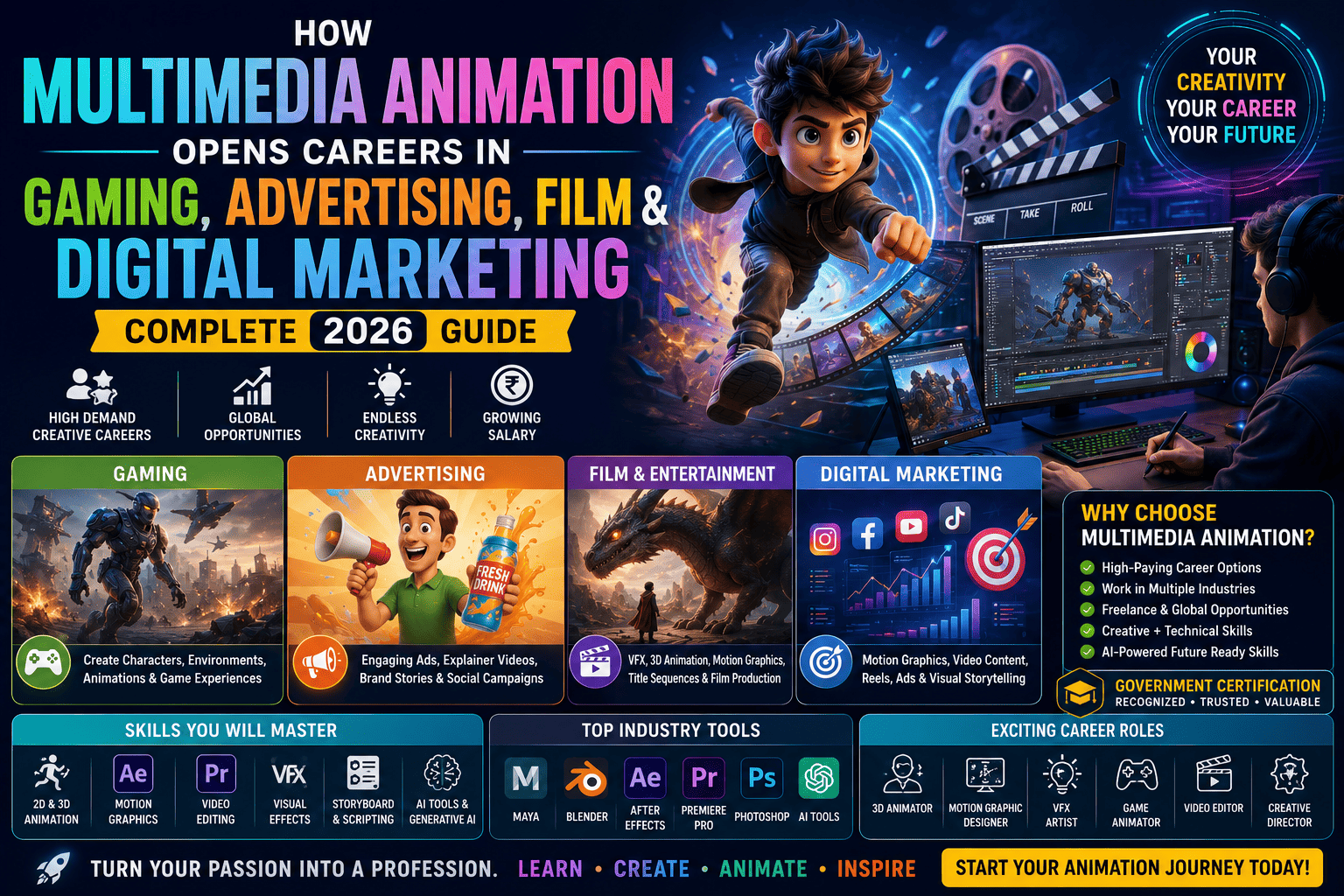
The creative industry is undergoing a remarkable transformation, and Multimedia Animation has become one of the most exciting career paths in 2026. From blockbuster films and immersive games to digital advertising campaigns and educational content, animation powers many of the visual experiences people interact with every day.
Modern Multimedia Animation goes beyond traditional cartoons. It combines 2D Animation, 3D Animation, Motion Graphics, Visual Effects (VFX), Video Editing, Graphic Design, UI/UX Design, Digital AI Filmmaking, Website Design & Development, Digital Marketing, and Generative AI Tools to create engaging digital content across industries.
Whether you’re a student after 12th, a graduate, a freelancer, or a creative professional looking to upskill, this guide explains how Multimedia Animation can lead to rewarding careers in gaming, advertising, film, digital marketing, and beyond.
What Is Multimedia Animation?
Multimedia Animation is the process of bringing ideas, characters, graphics, and stories to life through movement, sound, and visual effects.
It combines creativity, technology, and storytelling to create content for:
- Animated films
- Video games
- Television
- OTT platforms
- Social media
- Advertising
- Corporate communication
- E-learning
- Websites
- Mobile applications
Modern animation professionals often work across multiple creative disciplines rather than specializing in a single area.
Why Multimedia Animation Is Growing Rapidly in 2026
Digital content consumption continues to rise across industries.
Businesses increasingly use animation because it helps:
- Explain complex ideas
- Improve audience engagement
- Strengthen branding
- Increase social media reach
- Enhance learning experiences
- Improve product marketing
The growth of AI-powered creative tools has also made animation production faster and more accessible.
Career Opportunities in the Gaming Industry
Gaming is one of the fastest-growing sectors for Multimedia Animation professionals.
Animation plays a vital role in creating:
- Game characters
- Environments
- User interfaces
- Cutscenes
- Visual effects
- Character movements
- Interactive storytelling
Career Roles
- Game Animator
- Character Animator
- Environment Artist
- 3D Artist
- Game UI Designer
- Motion Designer
Professionals who understand both animation and user experience can contribute to immersive gaming experiences.
Animation in Advertising
Modern advertising relies heavily on animated visuals to capture attention quickly.
Animation is commonly used for:
- Social media campaigns
- Product launches
- Brand storytelling
- Explainer videos
- Digital billboards
- Corporate presentations
- Motion advertisements
Why Brands Prefer Animation
- Easy to understand
- Highly engaging
- Suitable for multiple platforms
- Supports brand identity
- Improves audience retention
Motion Graphics and short-form animated videos have become especially valuable for digital marketing campaigns.
Careers in Film and Entertainment
Animation has become an essential part of filmmaking.
Professionals contribute to:
- Animated movies
- Visual effects (VFX)
- Title sequences
- Motion graphics
- AI-assisted filmmaking
- Virtual production
- Storyboarding
- Cinematic trailers
With advancements in Digital AI Filmmaking, creative professionals can now combine traditional storytelling with AI-powered production tools.
Animation in Digital Marketing
Animation is a powerful communication tool in digital marketing.
Businesses use animated content for:
- Instagram Reels
- YouTube videos
- LinkedIn campaigns
- Product demonstrations
- Email marketing
- Website banners
- Landing page videos
Motion Graphics and Video Editing help brands create visually compelling campaigns that attract and retain audiences.
Essential Skills Every Multimedia Animator Should Learn
Creative Skills
- Storytelling
- Character Design
- Composition
- Color Theory
- Typography
- Visual Communication
Technical Skills
- 2D Animation
- 3D Animation
- Motion Graphics
- Video Editing
- Visual Effects
- Graphic Design
- UI/UX Basics
Professional Skills
- Creativity
- Communication
- Collaboration
- Time Management
- Problem Solving
Why Motion Graphics Is a Must-Have Skill
Motion Graphics combines Graphic Design and Animation to create dynamic visual content.
Applications include:
- Promotional videos
- Corporate communication
- Product explainers
- Social media ads
- Event presentations
- Brand videos
Motion Graphics professionals are in demand across advertising agencies, media companies, and corporate organizations.
Video Editing Complements Animation
Animation and Video Editing often work together.
Editors enhance animation projects through:
- Scene sequencing
- Audio synchronization
- Color correction
- Transitions
- Visual storytelling
Learning both disciplines increases career flexibility and improves production quality.
How Generative AI Is Transforming Animation
Artificial Intelligence is changing animation workflows by helping professionals:
- Generate concept art
- Create storyboards
- Produce animation references
- Generate voices
- Improve lip-sync
- Enhance backgrounds
- Speed up repetitive tasks
Popular AI tools include:
- ChatGPT
- Adobe Firefly
- Runway
- Kling AI
- Pika
- Midjourney
AI supports creativity but does not replace the artistic judgment, storytelling, and technical expertise required for professional animation.
Should Animators Learn Graphic Design and UI/UX?
Yes. Learning Graphic Design and UI/UX Design provides several advantages.
Graphic Design strengthens:
- Branding
- Typography
- Layout
- Visual hierarchy
UI/UX Design helps animators:
- Design interactive interfaces
- Improve user engagement
- Create app animations
- Build better digital experiences
Cross-disciplinary skills increase employability in modern creative teams.
Website Design & Development: An Added Advantage
Understanding website design enables Multimedia Animators to create:
- Interactive web animations
- Responsive motion elements
- Animated landing pages
- Digital portfolios
Basic knowledge of responsive design and front-end implementation can improve collaboration with developers.
Essential Software Every Multimedia Animator Should Learn
Animation
- Autodesk Maya
- Blender
- Toon Boom Harmony
Motion Graphics
- Adobe After Effects
- Cinema 4D
Graphic Design
- Adobe Photoshop
- Adobe Illustrator
Video Editing
- Adobe Premiere Pro
- DaVinci Resolve
UI/UX
- Figma
AI Tools
- ChatGPT
- Adobe Firefly
- Runway
- Midjourney
Industries Hiring Multimedia Animation Professionals
Animation professionals are needed in:
- Gaming
- Film Production
- OTT Platforms
- Advertising Agencies
- Digital Marketing Agencies
- IT Companies
- E-learning
- Healthcare
- Architecture
- Manufacturing
- Corporate Training
- Media Houses
Career Opportunities
After developing multimedia animation skills, you can pursue roles such as:
- Multimedia Animator
- 2D Animator
- 3D Animator
- Motion Graphic Designer
- VFX Artist
- Video Editor
- Game Animator
- Storyboard Artist
- Visual Designer
- Creative Producer
- Digital Content Creator
- Freelance Animator
Salary and Career Growth in 2026
Income varies depending on:
- Experience
- Portfolio quality
- Technical expertise
- Industry
- Company
- Project complexity
- AI proficiency
Professionals who continuously upgrade their skills and build a strong portfolio generally have better opportunities for career advancement.
Government Certification: Does It Help?
Government-recognized certification can demonstrate structured learning and formal training. However, employers also evaluate:
- Portfolio quality
- Practical projects
- Creativity
- Technical skills
- Teamwork
- Communication
Certification is most effective when combined with hands-on experience and continuous skill development.
Future Trends in Multimedia Animation
Key trends shaping the industry include:
- AI-assisted animation
- Virtual production
- Real-time rendering
- Interactive storytelling
- Extended Reality (XR)
- Immersive media
- Motion-first content
- Personalized digital experiences
- Cross-platform animation
- Cloud-based collaboration
Professionals who stay updated with these trends will be better prepared for the future of creative work.
Frequently Asked Questions (FAQs)
1. Is Multimedia Animation a good career in 2026?
Yes. Multimedia Animation offers opportunities across gaming, advertising, film, digital marketing, education, and many other industries as demand for engaging digital content continues to grow.
2. Can Multimedia Animation lead to careers outside entertainment?
Absolutely. Animation skills are valuable in corporate communication, healthcare, e-learning, architecture, manufacturing, digital marketing, and product visualization.
3. Should I learn Motion Graphics and Video Editing with Animation?
Yes. These complementary skills expand your creative capabilities and improve your ability to work on integrated multimedia projects.
4. Is Generative AI replacing animators?
Generative AI assists with ideation and repetitive tasks, but professional animation still depends on creativity, storytelling, technical expertise, and artistic direction.
5. Do I need coding knowledge for Multimedia Animation?
Coding is not required for most animation roles. However, basic knowledge of interactive media or web technologies can be beneficial for certain projects.
6. Is a government-certified Multimedia Animation course worth it?
A government-recognized certification can strengthen your profile by validating your training. Pairing certification with a strong portfolio and practical experience provides the greatest value.
Conclusion
Multimedia Animation has evolved into one of the most versatile creative career paths in 2026. It connects storytelling, technology, design, and digital communication, creating opportunities in gaming, advertising, film, digital marketing, education, and interactive media.
To maximize your career potential, build expertise beyond animation by learning Motion Graphics, Video Editing, Graphic Design, UI/UX Design, Website Design & Development, Digital AI Filmmaking, and Generative AI Tools. Combined with practical projects, a compelling portfolio, and continuous learning, these skills can help you adapt to industry changes and pursue diverse creative opportunities in the years ahead.
Comments are closed