


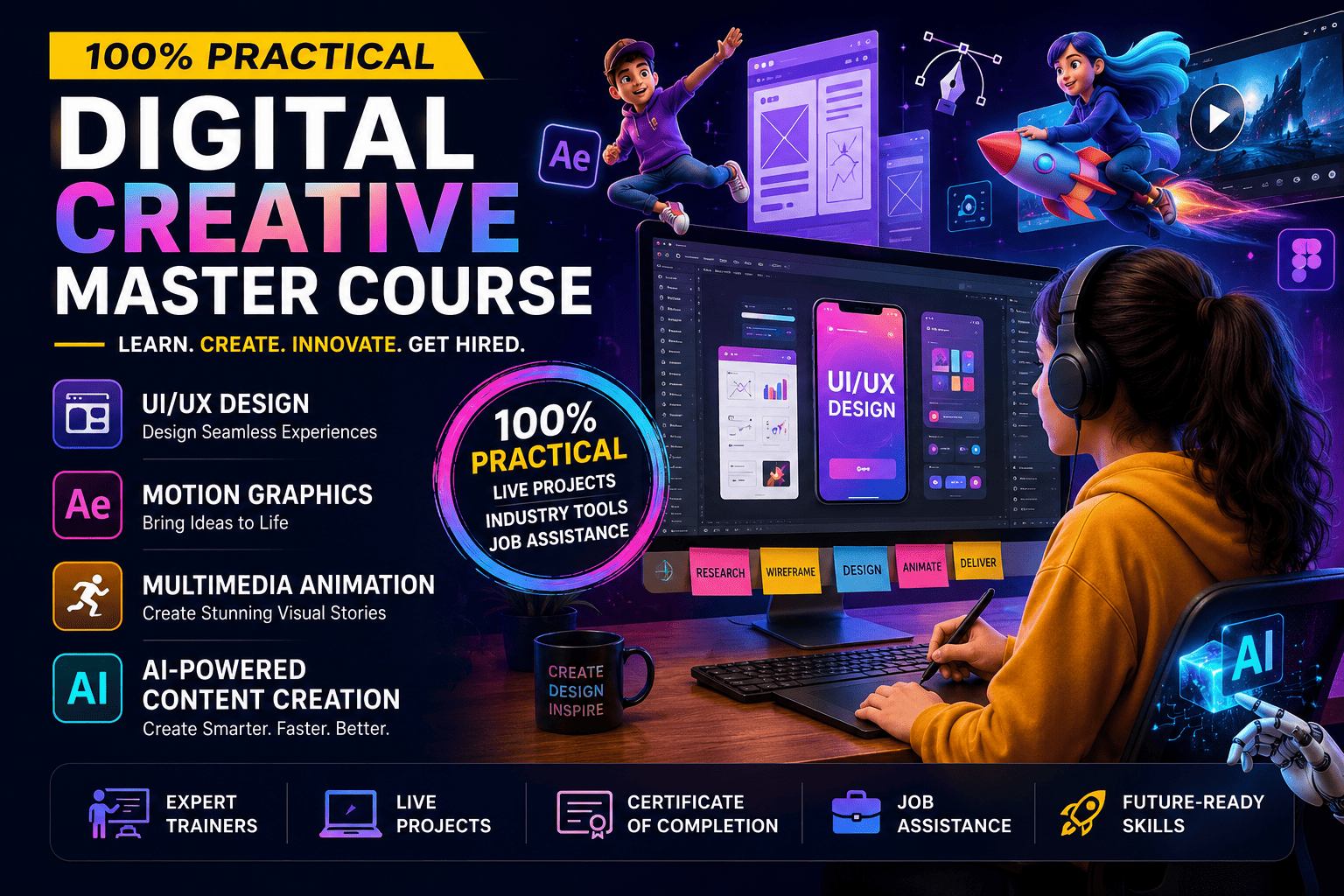
The digital creative industry is evolving rapidly as businesses increasingly rely on engaging user experiences, compelling visual content, animation, video production, and AI-assisted workflows. Employers seek professionals who can combine creativity with practical technical skills and modern AI tools.
A 100% Practical Digital Creative Master Course equips students with hands-on experience in UI/UX Design, Motion Graphics, Multimedia Animation, AI-Powered Content Creation, Graphic Design, and Video Editing. Through live projects, portfolio development, and industry-standard software, learners gain the confidence and practical knowledge needed for today’s digital workplace.
Why Practical Learning Matters in the Creative Industry
Creative careers are built on demonstrable skills rather than theory alone. Employers and clients typically evaluate portfolios, project experience, problem-solving ability, and software proficiency.
A practical training approach helps students:
- Apply concepts to real-world projects
- Develop creative thinking
- Learn industry workflows
- Improve collaboration skills
- Build a professional portfolio
- Gain confidence using modern creative tools
What Makes This Master Course Different?
Unlike software-only training, this course focuses on solving real design and communication challenges.
Students learn to:
- Design intuitive user interfaces
- Create engaging animations
- Produce professional videos
- Develop multimedia projects
- Use AI responsibly in creative workflows
- Present professional portfolios
The emphasis is on practical application through assignments and project-based learning.
Course Modules
1. UI/UX Design
Learn to create user-centered digital experiences for websites and mobile applications.
Topics Covered
- Design Thinking
- User Research
- Wireframing
- Information Architecture
- User Flows
- Interactive Prototypes
- Responsive Design
- Design Systems
- Accessibility Fundamentals
Tools
- Figma
- Adobe XD
- AI-assisted Design Tools
Career Opportunities
- UI Designer
- UX Designer
- Product Designer
- Interaction Designer
2. Motion Graphics
Bring static designs to life through engaging animation.
Students learn:
- Animation Principles
- Logo Animation
- Kinetic Typography
- Explainer Videos
- Social Media Motion Content
- Corporate Presentations
- Animated Advertisements
Software
- Adobe After Effects
- Adobe Premiere Pro
- Cinema 4D (Introduction)
Career Roles
- Motion Graphics Designer
- Animation Artist
- Creative Video Designer
3. Multimedia Animation
Explore visual storytelling through multimedia production.
Topics include:
- 2D Animation
- Character Animation
- Visual Storytelling
- Interactive Multimedia
- Corporate Animation
- Educational Content
Students develop projects that demonstrate animation principles and communication skills.
4. AI-Powered Content Creation
Generative AI is becoming an important part of creative workflows.
Students learn how AI can support:
- Content Ideation
- Script Drafting
- Image Generation
- Storyboarding
- Voice Assistance
- Video Production
- Creative Brainstorming
- Workflow Optimization
Popular AI Tools
- ChatGPT
- Adobe Firefly
- Runway
- Midjourney
- Canva AI
- Google Veo
- ElevenLabs
AI is introduced as a productivity tool that complements human creativity rather than replacing it.
5. Graphic Design
Master visual communication through:
- Branding
- Logo Design
- Typography
- Packaging Design
- Social Media Graphics
- Print Design
- Marketing Creatives
Software
- Adobe Photoshop
- Adobe Illustrator
- Adobe InDesign
6. Professional Video Editing
Create polished video content for businesses, creators, and digital platforms.
Topics include:
- Editing Techniques
- Storytelling
- Color Correction
- Color Grading
- Audio Editing
- Motion Titles
- Social Media Video Production
Software
- Adobe Premiere Pro
- DaVinci Resolve
Live Projects & Portfolio Development
Students strengthen their skills by completing practical projects such as:
- Mobile App UI Designs
- Website Interfaces
- Brand Identity Systems
- Motion Graphics Videos
- Multimedia Animations
- Promotional Videos
- Social Media Campaigns
- AI-assisted Creative Concepts
These projects help build a portfolio that demonstrates technical ability and creative problem-solving.
Industry Software You’ll Learn
Students gain experience with widely used creative tools, including:
- Figma
- Adobe Photoshop
- Adobe Illustrator
- Adobe InDesign
- Adobe After Effects
- Adobe Premiere Pro
- DaVinci Resolve
- Adobe XD
- ChatGPT
- Adobe Firefly
- Runway
- Canva AI
- Midjourney
- Google Veo
- ElevenLabs
Career Opportunities After Completing the Course
Graduates can pursue roles such as:
- UI Designer
- UX Designer
- Graphic Designer
- Motion Graphics Designer
- Multimedia Animator
- Video Editor
- AI Content Creator
- Visual Designer
- Creative Executive
- Digital Content Producer
- Freelance Creative Professional
Who Should Join This Course?
This course is suitable for:
- Students after 10th or 12th
- College students
- Graduates
- Job seekers
- Working professionals
- Freelancers
- Entrepreneurs
- Content creators
- Career changers
No prior experience is required, making it beginner-friendly while still offering value to learners who want to expand their existing skills.
Why Employers Value Practical Creative Skills
Organizations increasingly prefer professionals who can:
- Solve design challenges
- Create engaging visual content
- Produce multimedia assets
- Use AI tools effectively
- Communicate ideas clearly
- Collaborate with cross-functional teams
- Deliver projects using industry-standard software
A portfolio that demonstrates practical work is often one of the strongest indicators of readiness for creative roles.
Future-Proof Your Creative Career
Technology continues to evolve, but creativity, communication, and human-centered problem solving remain fundamental. Learning AI alongside design, animation, and multimedia production enables students to adapt to new workflows while maintaining strong creative foundations.
Continuous learning, practical experience, and portfolio development are key to long-term success in the digital creative industry.
Frequently Asked Questions (FAQs)
1. What is a Digital Creative Master Course?
It is a comprehensive program that teaches UI/UX Design, Motion Graphics, Multimedia Animation, Graphic Design, Video Editing, and AI-powered content creation through practical, project-based learning.
2. Is this course suitable for beginners?
Yes. The curriculum starts with foundational concepts and gradually introduces advanced techniques and professional workflows.
3. What software will I learn?
Students work with Figma, Adobe Photoshop, Illustrator, InDesign, After Effects, Premiere Pro, DaVinci Resolve, ChatGPT, Adobe Firefly, Runway, Midjourney, Canva AI, Google Veo, and other modern creative tools.
4. Will I build a professional portfolio?
Yes. Students complete practical assignments and live projects that contribute to an industry-ready portfolio.
5. Can AI replace creative professionals?
AI supports creative work by improving productivity and automating certain tasks, but creativity, strategy, storytelling, and design thinking remain essential human strengths.
6. What careers can I pursue after this course?
Graduates may explore careers in UI/UX Design, Motion Graphics, Multimedia Animation, Graphic Design, Video Editing, AI Content Creation, and freelance creative services.
7. Is practical training important?
Yes. Hands-on experience helps learners apply concepts, solve real problems, and demonstrate their abilities through a strong portfolio.
Conclusion
The demand for professionals who can combine design, animation, multimedia production, and AI-assisted workflows continues to grow across industries. A 100% Practical Digital Creative Master Course prepares students with the technical knowledge, creative thinking, and project experience needed for modern digital careers.
By mastering UI/UX Design, Motion Graphics, Multimedia Animation, Video Editing, Graphic Design, and AI-powered content creation, learners can build versatile skill sets, create compelling portfolios, and prepare for opportunities in agencies, startups, technology companies, media organizations, or freelance businesses.