


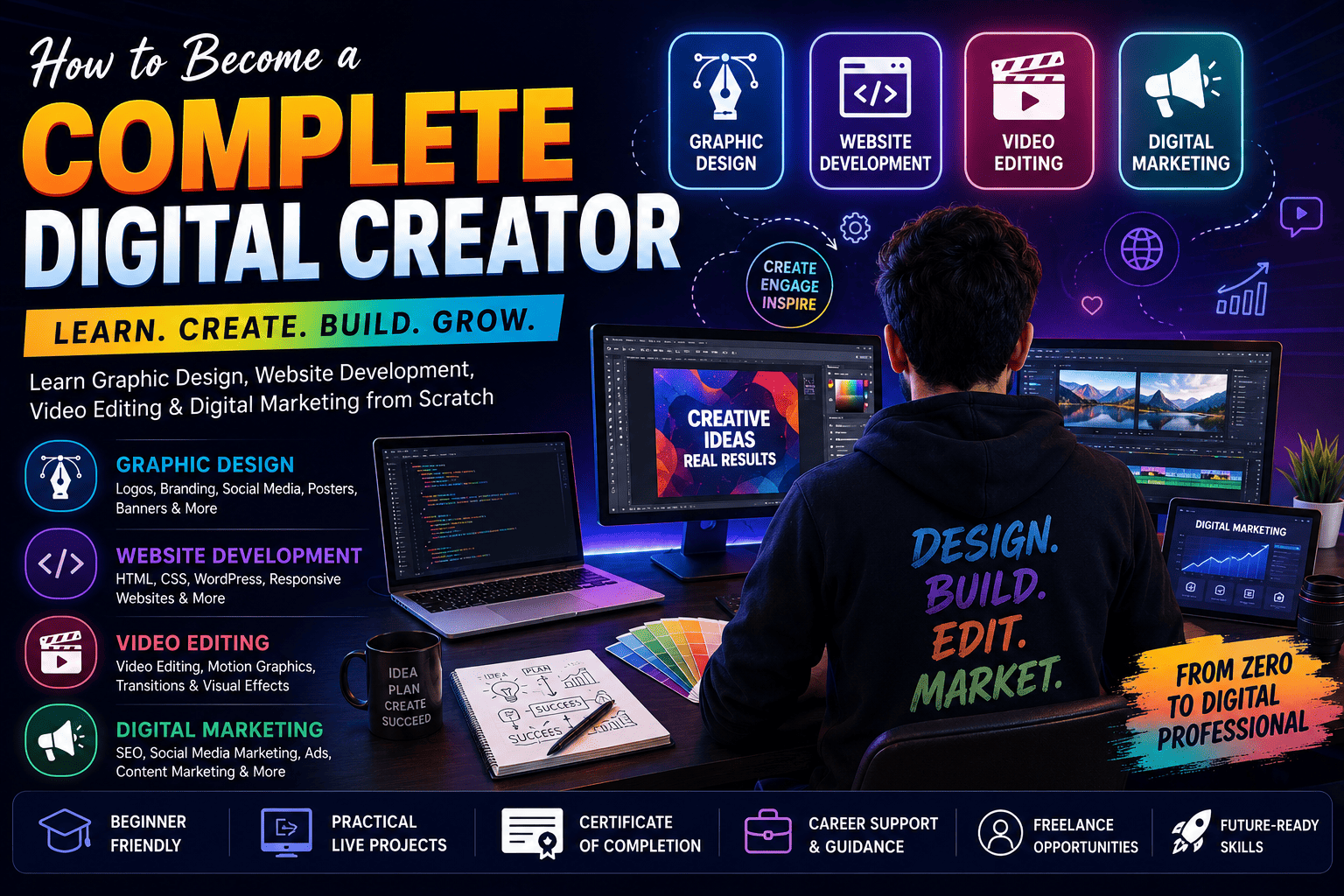
The digital economy is creating thousands of opportunities for skilled creators who can design, build, edit, and market content across multiple platforms. Companies no longer hire only designers or marketers—they increasingly seek professionals who understand the complete digital workflow.
Whether your goal is freelancing, launching a startup, becoming a content creator, or securing a high-paying job, learning Graphic Design, Website Development, Video Editing, and Digital Marketing together provides a strong competitive advantage.
This guide explains the complete roadmap to becoming a successful digital creator in 2026.
How to Become a Complete Digital Creator: Learn Graphic Design, Website Development, Video Editing & Digital Marketing from Scratch
The digital world has transformed how businesses communicate, sell products, and build their brands. From social media campaigns and websites to YouTube videos and online advertisements, every digital experience relies on creative professionals.
Instead of specializing in just one area, many employers now prefer multi-skilled digital creators who can handle several aspects of content creation and online marketing.
A complete digital creator combines creativity with technical knowledge, enabling them to produce engaging content while understanding how it reaches the right audience.
Why Digital Creators Are in High Demand in 2026
Every business today needs:
- Professional branding
- Modern websites
- Creative social media posts
- Promotional videos
- Online advertising
- Search Engine Optimization (SEO)
- AI-assisted content production
From startups to multinational companies, organizations increasingly seek professionals who can manage multiple digital responsibilities efficiently.
This growing demand has made digital creation one of the most promising career paths.
Step 1: Learn Graphic Design
Graphic design is the foundation of digital creativity.
It teaches you how to communicate visually through typography, colors, layouts, illustrations, and branding.
Skills You’ll Learn
- Logo Design
- Social Media Creatives
- Poster Design
- Banner Design
- Business Cards
- Packaging Design
- Branding
- UI Graphics
- Print Design
Popular Software
- Adobe Photoshop
- Adobe Illustrator
- Canva
- CorelDRAW
- Adobe Express
- Figma
Step 2: Learn Website Development
Every business needs a professional online presence.
Website development helps you create responsive, attractive, and user-friendly websites.
Topics Covered
- HTML
- CSS
- JavaScript
- Responsive Design
- WordPress
- Landing Pages
- Website Hosting
- Domain Setup
- Basic UI/UX
- Website Optimization
Career Opportunities
- Web Designer
- Front-End Developer
- WordPress Developer
- UI Designer
- Freelancer
Step 3: Master Video Editing
Video content dominates every digital platform.
Brands invest heavily in promotional videos, reels, YouTube content, advertisements, and online courses.
Learn
- Video Editing
- Color Correction
- Motion Graphics
- Transitions
- Audio Editing
- Visual Effects
- Reels Editing
- Corporate Videos
- YouTube Editing
Software
- Adobe Premiere Pro
- Adobe After Effects
- DaVinci Resolve
- CapCut
- Filmora
Step 4: Learn Digital Marketing
Creating content is only half the journey.
Digital marketing ensures your content reaches the right audience.
Learn
- SEO
- Google Ads
- Meta Ads
- Instagram Marketing
- Facebook Marketing
- LinkedIn Marketing
- Email Marketing
- Content Marketing
- Analytics
- AI Marketing
Step 5: Learn AI Tools
Artificial Intelligence has become an essential part of modern digital workflows.
Rather than replacing creativity, AI helps creators work faster by automating repetitive tasks, generating ideas, and improving productivity.
Popular AI Tools
- ChatGPT
- Adobe Firefly
- Canva AI
- Midjourney
- Gemini
- Microsoft Copilot
- Runway ML
- Kling AI
- Notion AI
Learning to use AI responsibly alongside creative skills can significantly improve efficiency and content quality.
Essential Skills Every Digital Creator Should Have
- Graphic Design
- Branding
- Website Design
- UI Basics
- Content Writing
- Copywriting
- Video Editing
- Motion Graphics
- Social Media Marketing
- SEO
- Google Ads
- Meta Ads
- Photography Basics
- AI Content Creation
- Communication Skills
- Creative Thinking
- Time Management
Tools Every Digital Creator Uses
| Category | Popular Tools |
|---|---|
| Design | Photoshop, Illustrator, Canva |
| UI Design | Figma, Adobe XD |
| Video | Premiere Pro, After Effects, DaVinci Resolve |
| Website | WordPress, VS Code |
| Marketing | Google Analytics, Google Ads, Meta Ads Manager |
| SEO | Google Search Console, Keyword Planner |
| AI | ChatGPT, Adobe Firefly, Gemini, Runway ML |
Career Opportunities
After completing a complete digital creator course, you can work as:
- Graphic Designer
- Website Designer
- Web Developer
- Video Editor
- Motion Graphics Artist
- Digital Marketing Executive
- SEO Specialist
- Social Media Manager
- Brand Designer
- UI Designer
- Content Creator
- YouTube Creator
- Freelancer
- Creative Consultant
- Digital Entrepreneur
Freelancing Opportunities
Digital creators can earn by offering services on freelance platforms or directly to clients, including:
- Logo Design
- Social Media Posts
- Website Design
- Video Editing
- SEO Services
- Content Creation
- Branding Packages
- Digital Advertising
- YouTube Editing
Salary Expectations in India (2026)
| Experience | Average Monthly Salary |
|---|---|
| Beginner | ₹20,000–₹35,000 |
| 1–3 Years | ₹35,000–₹60,000 |
| 3–5 Years | ₹60,000–₹1,00,000+ |
| Freelancer | Income varies by projects and client base |
Actual earnings depend on skills, location, portfolio, employer, and market demand.
Why Learn All Skills Instead of Just One?
Professionals with multiple complementary digital skills can:
- Handle complete client projects
- Improve employability
- Collaborate effectively across teams
- Build stronger portfolios
- Increase freelancing opportunities
- Adapt to changing industry trends
- Deliver end-to-end digital solutions
Who Should Join?
This learning path is suitable for:
- Students
- Graduates
- Job Seekers
- Entrepreneurs
- Freelancers
- Working Professionals
- Small Business Owners
- Content Creators
- Marketing Professionals
No prior experience is required to begin learning.
Tips to Become a Successful Digital Creator
- Build a strong portfolio.
- Practice with real-world projects.
- Stay updated with AI and industry trends.
- Learn both creative and marketing skills.
- Develop communication and presentation abilities.
- Network with professionals.
- Continuously refine your work based on feedback.
Frequently Asked Questions (FAQs)
1. What is a Complete Digital Creator?
A Complete Digital Creator is a professional who combines graphic design, website development, video editing, digital marketing, and AI-assisted content creation to produce engaging digital experiences.
2. Can I learn all these skills from scratch?
Yes. Many structured training programs start with the basics and gradually move to advanced practical projects.
3. Is coding necessary?
Basic HTML, CSS, and JavaScript are helpful for website development, but many websites can also be built using no-code or low-code platforms such as WordPress.
4. Which software should beginners learn first?
A practical starting combination includes Photoshop, Illustrator, Canva, WordPress, Premiere Pro, Figma, and basic AI tools.
5. Is digital marketing necessary for designers?
Understanding digital marketing helps designers create content that performs better online and aligns with business goals.
6. Can I freelance after learning these skills?
Yes. A strong portfolio and practical experience can help you offer services to clients locally or globally.
7. Are AI tools replacing digital creators?
AI is changing workflows, but human creativity, strategy, storytelling, and design thinking remain essential. AI is most effective when used to enhance—not replace—creative work.
8. Which industries hire digital creators?
Technology, e-commerce, education, healthcare, media, advertising, real estate, travel, manufacturing, startups, and many other sectors.
Conclusion
The future belongs to professionals who can combine creativity with technology. By learning Graphic Design, Website Development, Video Editing, Digital Marketing, and modern AI tools, you can build a versatile skill set that supports careers in employment, freelancing, entrepreneurship, and content creation.
Success as a digital creator comes from consistent practice, a well-developed portfolio, and a willingness to keep learning as tools and platforms evolve. Whether you are a student, a career changer, or a business owner, investing in these integrated digital skills can open doors to a wide range of opportunities in the growing digital economy.