


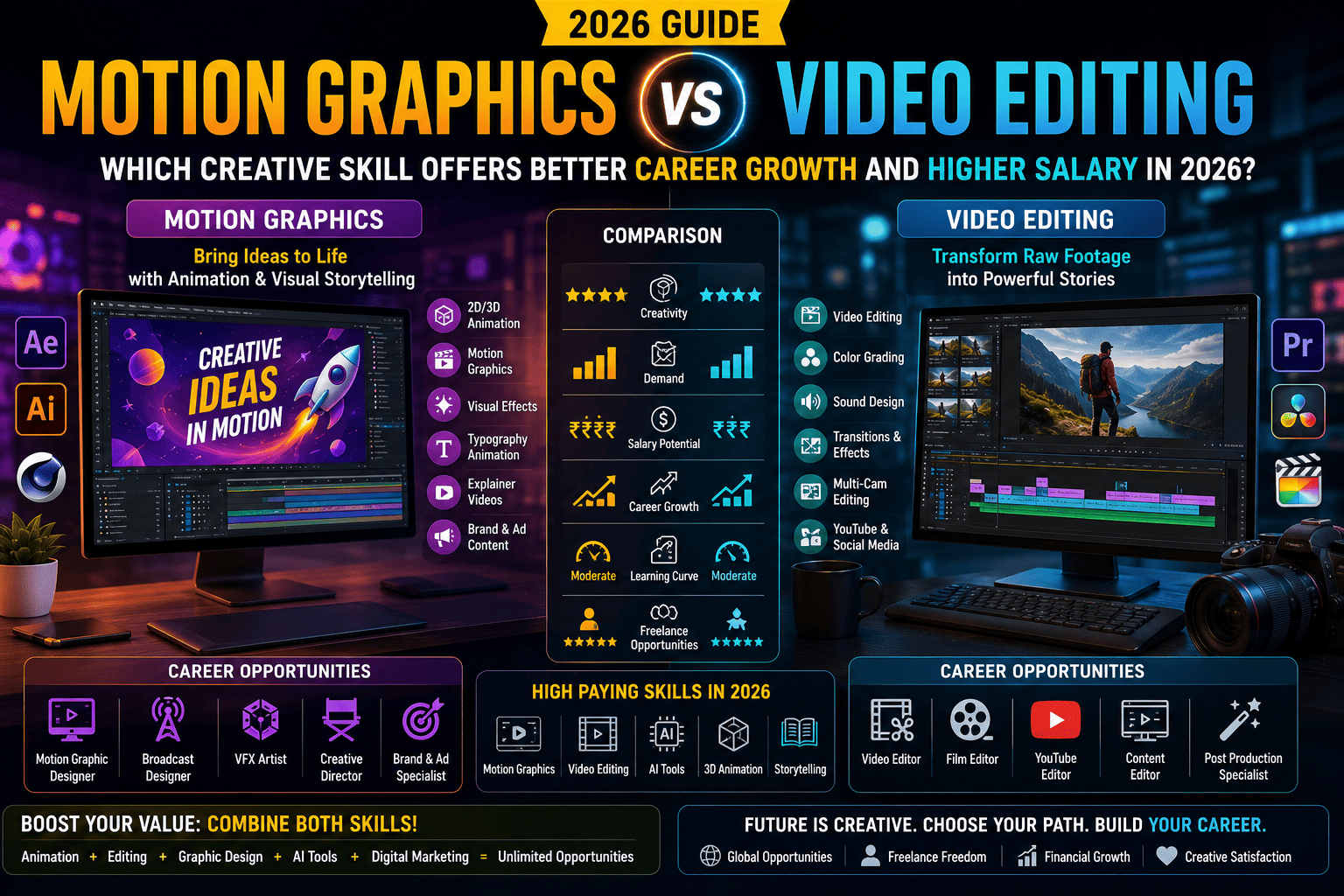
The digital content industry has transformed how businesses communicate with audiences. Every day, millions of videos are created for YouTube, OTT platforms, social media, advertising campaigns, films, online education, and corporate branding. Behind these engaging visuals are two highly sought-after creative professionals: Motion Graphic Designers and Video Editors.
Although both careers work with video content, they involve different creative processes and technical skills. Motion Graphics focuses on animation, visual storytelling, typography, and graphic elements, while Video Editing is centered on assembling footage, enhancing storytelling, adding sound, transitions, and visual effects.
In 2026, both careers offer excellent opportunities, especially when combined with Graphic Design, Multimedia Animation, Digital AI Filmmaking, UI/UX Design, Website Design & Development, Digital Marketing, and Generative AI Tools. This guide compares both career paths, helping students and professionals choose the right direction based on skills, career goals, and industry demand.
Understanding Motion Graphics
Motion Graphics is the art of bringing graphic elements to life through animation. It combines design, typography, illustrations, transitions, and movement to communicate ideas visually.
Motion Graphics is widely used for:
- Brand promotions
- Logo animations
- Social media advertisements
- Corporate presentations
- Explainer videos
- Product launches
- Event visuals
- Digital campaigns
Unlike traditional animation, Motion Graphics emphasizes animated design elements rather than character-based storytelling.
What Does a Video Editor Do?
Video Editing involves organizing and refining raw footage into compelling visual stories.
A Video Editor is responsible for:
- Selecting the best footage
- Scene sequencing
- Audio synchronization
- Color correction
- Sound enhancement
- Visual effects integration
- Subtitle creation
- Final video delivery
Video Editors ensure that content is engaging, professional, and suitable for different digital platforms.
Motion Graphics vs Video Editing: Key Differences
| Feature | Motion Graphics | Video Editing |
|---|---|---|
| Primary Focus | Animation and graphic movement | Editing recorded footage |
| Creativity | Very High | High |
| Storytelling | Visual storytelling through graphics | Storytelling through sequencing |
| Design Skills | Essential | Helpful |
| Animation Skills | Required | Basic to intermediate |
| Software Focus | After Effects, Cinema 4D | Premiere Pro, DaVinci Resolve |
| AI Integration | High | High |
| Freelancing Opportunities | Excellent | Excellent |
Which Skill Is More in Demand in 2026?
The demand for both Motion Graphics and Video Editing continues to grow due to increasing digital content consumption.
Motion Graphics Demand
Organizations use Motion Graphics for:
- Advertising
- Branding
- Digital Marketing
- Product demonstrations
- Mobile applications
- UI animations
- Corporate communication
Video Editing Demand
Video Editors are needed for:
- YouTube creators
- OTT platforms
- Film production
- Digital marketing agencies
- Wedding production
- Educational platforms
- Corporate training
- News and media
Both fields offer excellent career prospects, with demand varying by industry and specialization.
Career Opportunities in Motion Graphics
Motion Graphics professionals can work as:
- Motion Graphic Designer
- Broadcast Designer
- Advertising Designer
- Digital Content Designer
- Brand Motion Designer
- Visual Effects Artist
- UI Motion Designer
- Creative Designer
Motion Graphics is especially valuable for professionals interested in branding, advertising, and digital media.
Career Opportunities in Video Editing
Video Editors can pursue roles such as:
- Video Editor
- Film Editor
- Content Editor
- YouTube Editor
- Corporate Video Editor
- Social Media Video Editor
- Documentary Editor
- Post-Production Editor
Video Editing is a versatile skill applicable across entertainment, education, marketing, and corporate communication.
Which Career Offers Better Salary in 2026?
Salary depends on multiple factors, including:
- Experience
- Portfolio quality
- Industry
- Technical skills
- Software expertise
- AI proficiency
- Freelance projects
- Geographic location
Motion Graphic Designers with expertise in branding, advertising, and advanced animation often command strong compensation. Likewise, experienced Video Editors specializing in film production, commercial advertising, or high-quality digital content can also achieve competitive earnings.
Rather than focusing solely on one discipline, combining both skills can significantly improve career prospects.
Essential Skills for Motion Graphics
Successful Motion Graphic Designers should learn:
- Typography
- Animation Principles
- Color Theory
- Composition
- Storytelling
- Branding
- Graphic Design
- Motion Design
- Visual Effects
Essential Skills for Video Editing
Professional Video Editors should develop expertise in:
- Video Storytelling
- Audio Editing
- Color Grading
- Scene Sequencing
- Camera Angles
- Sound Design
- Visual Effects
- Content Optimization
Software You Should Learn
Motion Graphics
- Adobe After Effects
- Cinema 4D
- Blender
- Adobe Illustrator
Video Editing
- Adobe Premiere Pro
- DaVinci Resolve
- Final Cut Pro
- CapCut
Learning complementary software improves versatility and expands career options.
How Generative AI Is Changing Both Careers
Artificial Intelligence has become a valuable assistant for creative professionals.
AI Helps Motion Graphic Designers
- Generate design concepts
- Create animated assets
- Produce motion templates
- Automate repetitive tasks
- Generate backgrounds
AI Helps Video Editors
- Auto-edit footage
- Remove background noise
- Generate subtitles
- Create voiceovers
- Improve color correction
- Detect highlights
Popular AI tools include:
- ChatGPT
- Adobe Firefly
- Runway
- Kling AI
- Pika
- Descript
- Canva AI
AI improves efficiency but does not replace creativity, storytelling, or artistic judgment.
Should You Learn Graphic Design Too?
Absolutely.
Graphic Design strengthens both Motion Graphics and Video Editing by improving:
- Typography
- Branding
- Composition
- Visual hierarchy
- Layout design
- Color selection
A strong design foundation enhances the quality of motion graphics and video content.
Why Multimedia Animation Is an Excellent Companion Skill
Multimedia Animation expands your expertise by introducing:
- Character Animation
- 2D Animation
- 3D Animation
- Visual Effects
- Interactive Storytelling
Professionals who understand animation often have greater flexibility in creative industries.
How Digital Marketing Adds Career Value
Businesses increasingly seek creative professionals who understand marketing objectives.
Knowledge of Digital Marketing enables you to create:
- High-performing advertisements
- Social media campaigns
- SEO-friendly videos
- Brand storytelling
- Performance marketing creatives
Understanding audience behavior helps improve the effectiveness of visual content.
Government Certification: Does It Matter?
Government-recognized certification can validate your formal training and demonstrate structured learning. However, employers generally evaluate candidates based on:
- Portfolio quality
- Creativity
- Practical experience
- Software proficiency
- Communication skills
- Ability to solve creative challenges
A certification is most valuable when paired with real-world projects and continuous skill development.
Who Should Choose Motion Graphics?
Choose Motion Graphics if you:
- Enjoy animation
- Love branding and advertising
- Are passionate about visual storytelling
- Like creating dynamic graphics
- Want to work in creative agencies or digital media
Who Should Choose Video Editing?
Choose Video Editing if you:
- Enjoy storytelling through film
- Like editing real footage
- Want to work in film, OTT, YouTube, or media
- Enjoy cinematic production
- Like organizing and enhancing visual content
Why Learning Both Skills Is the Best Career Strategy
The most successful creative professionals often combine:
- Motion Graphics
- Video Editing
- Graphic Design
- Multimedia Animation
- Digital AI Filmmaking
- UI/UX Design
- Website Design & Development
- Digital Marketing
- Generative AI
This multidisciplinary approach enables professionals to handle complete content production workflows, making them valuable across industries.
Industries Hiring Motion Graphic Designers & Video Editors
- Advertising Agencies
- Film Production Houses
- OTT Platforms
- Television Networks
- Digital Marketing Agencies
- E-learning Companies
- IT Companies
- Startups
- Healthcare
- Real Estate
- Manufacturing
- Corporate Communication
- Media Organizations
Future Trends in 2026
Creative professionals should prepare for:
- AI-assisted video production
- Virtual production
- Interactive motion graphics
- Personalized video marketing
- Real-time collaboration
- Short-form content creation
- Immersive storytelling
- Cloud-based editing workflows
- Motion-first social media campaigns
Frequently Asked Questions (FAQs)
1. Which is better in 2026: Motion Graphics or Video Editing?
Both offer strong career opportunities. Motion Graphics is ideal for branding and animation-focused roles, while Video Editing suits storytelling, film, and content production. Learning both provides greater versatility.
2. Can I learn Motion Graphics after Video Editing?
Yes. Many professionals begin with Video Editing and later add Motion Graphics to expand their creative capabilities and career options.
3. Are AI tools replacing Motion Graphic Designers and Video Editors?
No. AI assists with repetitive tasks, but creativity, storytelling, artistic direction, and problem-solving remain essential human skills.
4. Which software should beginners learn first?
Beginners interested in Motion Graphics often start with Adobe After Effects and Illustrator. Those focusing on Video Editing commonly begin with Adobe Premiere Pro or DaVinci Resolve.
5. Is Graphic Design important for Motion Graphics?
Yes. A strong understanding of Graphic Design improves typography, layout, branding, and overall visual quality, making Motion Graphics more effective.
6. Does a government-certified course help?
A government-recognized certification can strengthen your profile, but employers generally place equal or greater emphasis on your portfolio, practical skills, and project experience.
Conclusion
Both Motion Graphics and Video Editing are highly valuable creative skills in 2026, each offering rewarding career paths across advertising, film, digital marketing, OTT platforms, corporate communication, and content creation. Rather than viewing them as competing disciplines, they are increasingly complementary in modern production workflows.
For long-term success, consider building a broader skill set that includes Graphic Design, Multimedia Animation, UI/UX Design, Website Design & Development, Digital AI Filmmaking, Digital Marketing, and Generative AI Tools. By combining technical expertise with creativity, practical experience, and a strong portfolio, you can position yourself for sustained career growth in the rapidly evolving digital media industry.